Open the Town of Los Gatos's current fee schedule, effective July 1, 2026, and you'll find exactly one line item specific to accessory dwelling units: the use and occupancy clearance fee. It reads $0.00. Waived outright.
That zero is real. It's also the reason homeowners who budget an ADU project off the town's own paperwork tend to get a second bill they never saw coming, and it arrives from an agency whose name doesn't appear anywhere on the Town's fee page.
If you're a Los Gatos homeowner weighing an ADU for rental income before you list, or a buyer sizing up whether a property's backyard has room for one, the construction cost is the part every contractor's website will walk you through. The part that catches people off guard is everything sitting outside the Town's jurisdiction entirely.
What the Town Actually Charges, and What It Doesn't
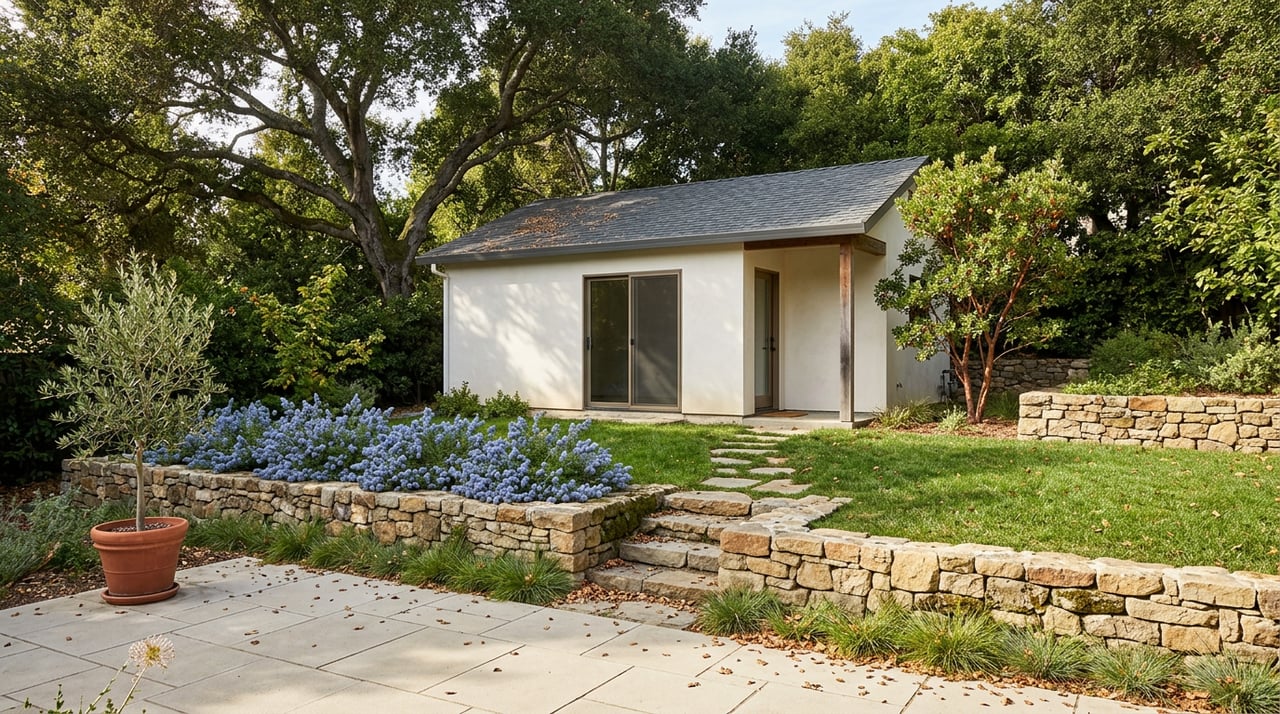
Los Gatos runs ADU permits through its Community Development Department, split between Planning (zoning and site compliance) and Building (the construction permit and plan check), on a single unified application rather than two separate submittals. That's a genuine convenience. Because ADUs in California are approved ministerially, meaning no public hearing and no discretionary review by neighbors or a planning commission, a complete application has a 60-day decision clock under state law.
None of that changes the fact that the Town's own fee schedule covers Community Development's piece of the process almost exclusively. The Building Division's actual permit and plan check cost is calculated off construction valuation rather than published as a flat number, so there's no single dollar figure to point to there either. What the schedule does not cover, and doesn't mention, is sewer.
The Invoice That Comes From a Different Building Entirely
Los Gatos sits inside West Valley Sanitation District, a special district that is not part of the Town and issues its own permit for any ADU, separate from your Town building permit. For a detached ADU, that means a capacity buy-in charge: a Sewer System Connection fee and a Treatment Plant Capacity fee, both assessed per plumbing-code drainage fixture unit. WVSD's own adopted budget for fiscal year 2025-2026 set those rates at $567.68 and $86.42 per fixture unit respectively, up to a capped maximum that depends on how many fixtures your unit has. That fiscal year closed June 30, 2026, so confirm the current figure with the district directly rather than treating last year's rate as this year's bill. A one-bedroom ADU with a kitchen and full bath easily runs eight to twelve fixture units once you count sinks, the toilet, the shower, and laundry hookups. Do that math and the WVSD invoice alone can land in the thousands before a shovel touches the ground.
On top of the capacity fee, WVSD charges its own permit processing fee, typically a few hundred dollars depending on whether your lot has an existing sewer lateral or needs a new one, and its review adds three to ten business days to the timeline. None of it shows up when you're reading the Town's page and assuming that's the whole bill.
The fix here isn't complicated. It's sequencing. Call West Valley Sanitation District early, before you finalize a construction budget, and get a real fixture-unit count and a real number, rather than discovering it at invoice time.
If Your Lot Slopes, There's a Second Gate Before You Even Get to a Floor Plan
Sewer isn't the only place where the Town's standard process branches. If your parcel sits in a Hillside Residential or Resource Conservation zone, which describes a meaningful share of Los Gatos property as the terrain climbs toward the Santa Cruz Mountains, you can't jump straight to a site plan.
Under the Town's 2004 Hillside Development Standards and Guidelines, hillside lots require a Least Restrictive Development Area analysis first: a site-specific study, typically prepared by a civil engineer or geologist, that maps the portion of your lot where building is actually appropriate given slope, access, and geologic conditions. The framework uses a 30 percent slope threshold as one of its criteria under Town Code Section 29.10.320(3)(d). Until that analysis is done, an ADU's location on a hillside lot isn't really a design choice yet. It's an open question with an engineering answer.
That step adds real time. A standard, flat-lot ADU application can move through in four to eight weeks. Add a required LRDA analysis and you're commonly looking at ten to sixteen weeks before the site plan is even finalized, not counting the plan check itself.
A related, smaller-scale example of local nuance: if your home sits inside downtown's Landmark and Historic Preservation combining district, Town Code Section 29.10.320(8)(a)(2) exempts an ADU there from the off-street parking requirement entirely, a real savings. The trade is that you can't site the ADU in front of a primary dwelling that's a designated historic resource. Neither of these rules is intuitive from a state-law ADU guide written for a flat suburban grid. Both are specific to how Los Gatos zones its own hillsides and its own downtown.
The Rulebook Is Being Rewritten While This Is Being Read
Here's the part that matters most for anyone timing a project around today's numbers: Los Gatos is not just tweaking its fee schedule this year. It's rewriting its own ADU ordinance, Town Code Chapter 29, Article I, Division 7, which dates to a 2020 update. California's Housing and Community Development department sent the Town a formal findings letter on that ordinance back in October 2023, and a 2025 amendment to state law (an update to SB 9) now gives HCD real enforcement power: if a city's ADU ordinance doesn't comply with state law and the city doesn't fix it after notice, HCD can void the noncompliant parts and state minimum standards apply instead.
That's the pressure behind the current rewrite. The Planning Commission reviewed a draft on June 10, 2026, and forwarded a recommendation to the Town Council, which took up the draft on August 4, 2026. By the time you're reading this, that hearing has already happened, and the adopted language may already differ from what's described here. Confirm current status directly with the Planning Division before finalizing plans against any local rule cited in this post or anywhere else.
Separately, four state bills took effect January 1, 2026, and apply in Los Gatos regardless of where the local rewrite lands. The one with the most direct budget impact is SB 543, which shifts ADU size measurement to interior livable space and expands the impact fee exemption to any ADU at 750 square feet or less, 500 or less for a Junior ADU. If your project design lands right at that threshold, a few square feet of interior measurement can be the difference between an exempted fee category and one that isn't.
A jurisdiction with an open HCD findings history doesn't get to treat its own ADU ordinance as settled. Los Gatos is one of them right now.
What This Means If You're Preparing to Sell
An ADU can be a genuine value-add on a Los Gatos listing, both as documented rental income and as flexible space for multigenerational buyers. But a half-finished or improperly permitted ADU is a liability in disclosures, not an asset. If you're adding one with an eye toward selling in the next year or two, build in the WVSD lead time and, if you're on a hillside parcel, the LRDA lead time, before you set a listing date. A permitted ADU with clean paperwork from both the Town and West Valley Sanitation District is worth describing plainly to a buyer's agent. An ADU with an open question about sewer capacity buy-in is worth resolving before it ever reaches a disclosure form.
What This Means If You're Evaluating a Property's ADU Potential
If you're touring Los Gatos homes with an ADU in mind, whether to offset a mortgage or house a family member, ask two questions before you get attached to a floor plan: what zone is the lot in, and has anyone already engaged West Valley Sanitation District about capacity. A flat lot in a standard residential zone is a different project, in cost and in timeline, than a hillside parcel in HR or RC zoning. Neither is disqualifying. But the difference between them is exactly the kind of detail a national cost guide won't tell you, and exactly the kind of detail worth confirming before an offer, not after closing.
A Few Questions Worth Asking Before You Commit
Will my neighbors get a say in whether I build an ADU? No. ADUs that meet state and local standards are approved ministerially in Los Gatos, meaning there's no public hearing and no discretionary review.
Does the Town's fee schedule cover everything I'll be billed for? No. It covers Community Development's Planning and Building review. West Valley Sanitation District bills separately for sewer capacity, and it isn't part of the Town.
What if my lot is on a slope? If it's zoned Hillside Residential or Resource Conservation, a Least Restrictive Development Area analysis, typically done by a civil engineer or geologist, has to identify a buildable envelope before your site plan can be finalized. Budget real time for it.
Every one of these details is confirmable with a phone call before you spend a dollar on design. That's the whole point of asking early.
If you're weighing an ADU on a Los Gatos property, whether you're preparing to list or sizing up a purchase, Mark Vantress can walk through what a specific lot's zoning and utility situation actually means for your timeline and your budget. Let's Connect.